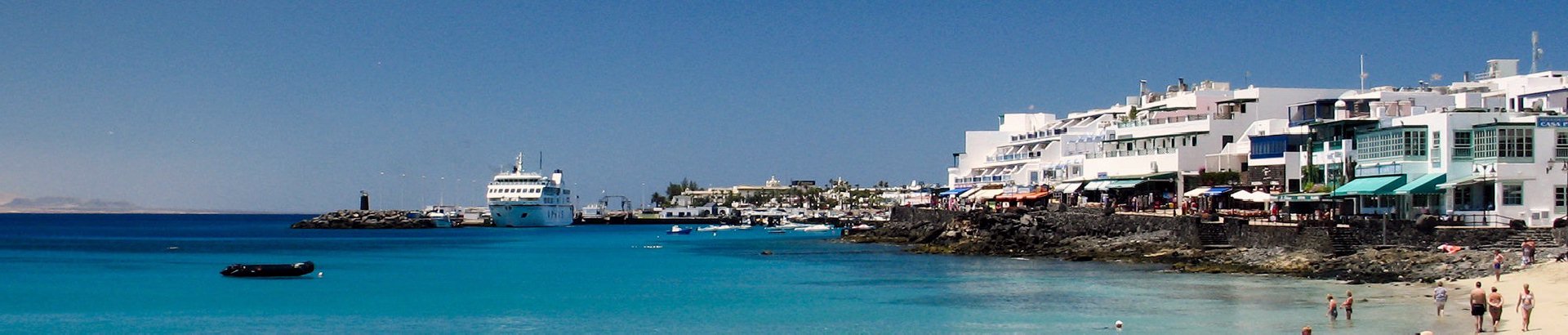
As we have already briefly mentioned on our general introduction pages, the
focal point of Playa Blanca is undoubtedly the magnificent Rubicon development
which comprises a 400 berth marina and upmarket commercial centre. If you are
looking for designer labels, this is certainly the place in Playa Blanca to go
to.
The Rubicon Marina has also attracted many leisure services organisation to base
their businesses here. These include the Rubicat catamaran, which at 23 metres,
is licensed to carry up to 100 passengers and Rubisail, which is a state of the
art sailing and windsurfing school. For more information, the contact details of
the Rubicon development are:
Puerto Deportivo Marina Rubicon
Urbanizacion Castillo del Aguila, s/n
35570
Playa Blanca
Lanzarote
Telephone: +34 928 519 012
Fax: +34 928 519 035
Web site:
www.marinarubicon.com
Something we haven't mentioned before is that this area of Lanzarote is actually
the nearest point to the neighbouring island of Fuerteventura, and on most days
it is possible to clearly see the resort of Corralejo in the distance. Fred
Olsen Lines run a daily high speed ferry service from Playa Blanca to Corralejo,
and it takes just 20 minutes to make the short crossing. Advance bookings are
recommended in high season, and also if you are planning to take a car with you.
Contact details are:
Edificio Fred Olsen
Poligono Industrial Anaza, s/n
Santa Cruz de Tenerife
Telephone: +34 922 628 200
Fax: +34 922 628 232
Web site:
www.fredolsen.es
Public transport around Playa Blanca is actually quite limited, although in all
fairness the
Transporte Interurbano de Lanzarote
do operate a bus service into
Arrecife
roughly every 90 minutes from around 10:00am.
For this reason if you wish to see more of the island, we would strongly
recommend a 2 or 3 days car hire. Overall the municipal district of Yaiza is
home to some of the most widely visited natural attractions on Lanzarote.
The most impressive, in our view at least, is undoubtedly the cliffs of Los
Hervideros, otherwise known as "The Boiling Pans". These are a series of caves
and blow holes that have been eroded into a former lava flows since the last
eruption. As the Atlantic waves crash into these caves, mountains of white surf
are produced, giving the appearance of boiling water. This is certainly one
place on Lanzarote that swimming is not recommended at any time.
Another less spectacular feature is the green lagoon at El Golfo. This is a
semi-circular volcanic crater that has filled with sea water, in which algae has
grown giving it a highly distinctive green colour.
Also one of the most bizarre sights around Yaiza that few, if any, tourists ever
get to see is the twice daily camel parade through the village of Uga. Whilst
thousands of visitors each year experience a ride along the slopes of Timanfaya
on the backs of these beasts, I doubt if anyone has actually ever considered
where they are stabled at the end of the working day.
Returning if we may back to the coast around Playa Blanca, immediately before
the Papagayo headland to the west of the resort is a small outcrop known as the
Punta del Aguila, or Eagle's Point.
Whilst in living memory eagles have never been seen here, it is however to site
of the defensive position known as the Castillo de las Coloradas. Although the
term "Castillo" or Castle may be a little too grand to describe this structure,
it was however built in 1769 on the instructions of King Carlos III of Spain to
give the south of the island early warning of approaching pirates.
 Home
Home